

How Is Our World Communion?
Rev. Erik Swanson
October 4, 2026
You can watch the sermon video here.
It seems more important than ever to me that we celebrate World Communion Sunday. Each year, this celebration reminds us that we are called to be in communion with the world — with its people and with the Creation that holds us all. That message stands in stark contrast to so much of what we see around us that seeks to divide us, separate us, and turn us against one another. In a political season filled with advertisements designed to make us fear or distrust one group or another, I believe we need to focus intentionally on what brings us together.
Connected To One Another, God And Community
The word communion comes from the Latin communio, meaning sharing or mutual participation. That gives me a deeper appreciation for what happens at this table. Holy Communion is meant to remind us that we are connected — to one another, to God, and to the larger community of humanity. It is a celebration of our commonality and our oneness in the Spirit. World Communion Sunday reminds us that, regardless of what the systems of the world throw at us, we remain bound together by the Spirit that is God.
The Parable Of The Tenants
The parable of the tenants (Matthew 21:33-46) offers a powerful warning about what happens when we forget our right place in the world. The tenants had a legitimate claim to their share of the harvest, but they allowed their egos and their sense of power to grow until they believed they could take whatever they wanted. Eventually, they responded with violence. I see something of ourselves in that story. We can convince ourselves that we are more important than others, that we deserve more space, more resources, or more power. We can dominate conversations, relationships, communities, and even the planet itself.
Finding The Right Balance
Finding our right place does not mean becoming insignificant or allowing ourselves to be treated as doormats. It means finding the balance between humility and dignity, recognizing that we are neither greater nor lesser than our fellow human beings. That understanding can deepen our communion with one another and with our Creator.
I see the same dynamics playing out in our country and around the world. When someone's words make us uncomfortable, we attack them. When another person's way of life makes us feel insecure, we demonize them. Nations invade other nations for resources. Political leaders sometimes avoid difficult realities by attacking others, creating distractions, or encouraging fear. All of this breaks our unity and shatters our communion.
The Inner Pharisee
The ending of the parable is especially powerful because the religious leaders understand that Jesus is talking about them — and then respond by trying to get rid of him. They become the very people the parable warns us not to be. And before I condemn them, I have to look at myself. Two thousand years later, we are the ones who are supposed to know better. Where is the “inner Pharisee” in my own life? Where am I allowing ego, fear, judgment, or the desire for control to interfere with my communion with others?
A Common Humanity And Spirit
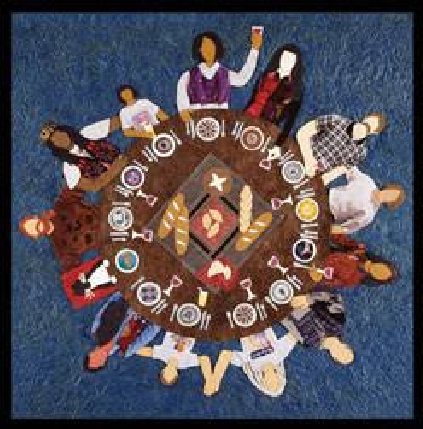
We are made up of many cultures and traditions. No one is better than another. Everyone is welcome, important, and valuable. We are connected to siblings gathering around tables in Mexico, Russia, Israel, Palestine, Sudan, Iran, Australia, and throughout the world. We share a common humanity and a common Spirit, and there is far more that connects us than divides us.
Our Communion With Creation
Our communion also extends beyond humanity to Creation itself. For decades, scientists have warned us that our relationship with the planet is out of balance. We have poisoned the water, air, and soil and treated Creation as something to dominate rather than something to tend. I am particularly moved by what I have learned from Indigenous peoples about living in a more respectful relationship with the natural world. Their traditions often emphasize reverence, gratitude, and an understanding that human beings have a place within Creation rather than above it.
Our industrialized society can make it easy to forget those deeper rhythms. We become so absorbed in our screens and our busy lives that we forget to sit beneath a tree, feel the breeze, or simply appreciate the beauty of the world around us. Those experiences can reconnect us with Creation and remind us that our calling is not to dominate it, but to care for it.
The Eucharist
So when I come to the Eucharist, we want to approach it as a place of holy communion. Through the tangible elements of bread and cup, we open ourselves to the mystery of the Holy and to a deeper connection with ourselves, with one another, with God, and with Creation. We share this ritual with millions and billions of people around the world and with generations of people who have come before us.
That is both stunning and wonderful to me. When I come to the Eucharist table, we want to remember and celebrate our deep connection with all our siblings — with people of different cultures, perspectives, backgrounds, identities, and stories. We are all part of this amazing body held together by the Spirit.
Celebrating Our Connection To The Creator and Creation
And so, on this World Communion Sunday, I want to celebrate not only our connection to the Creator, but also our connection to everything that has been created. May we find our right place, let go of the things that divide us, care for one another and for the Earth, and live more fully into the communion that has always connected us. May it be so today and always. Amen.